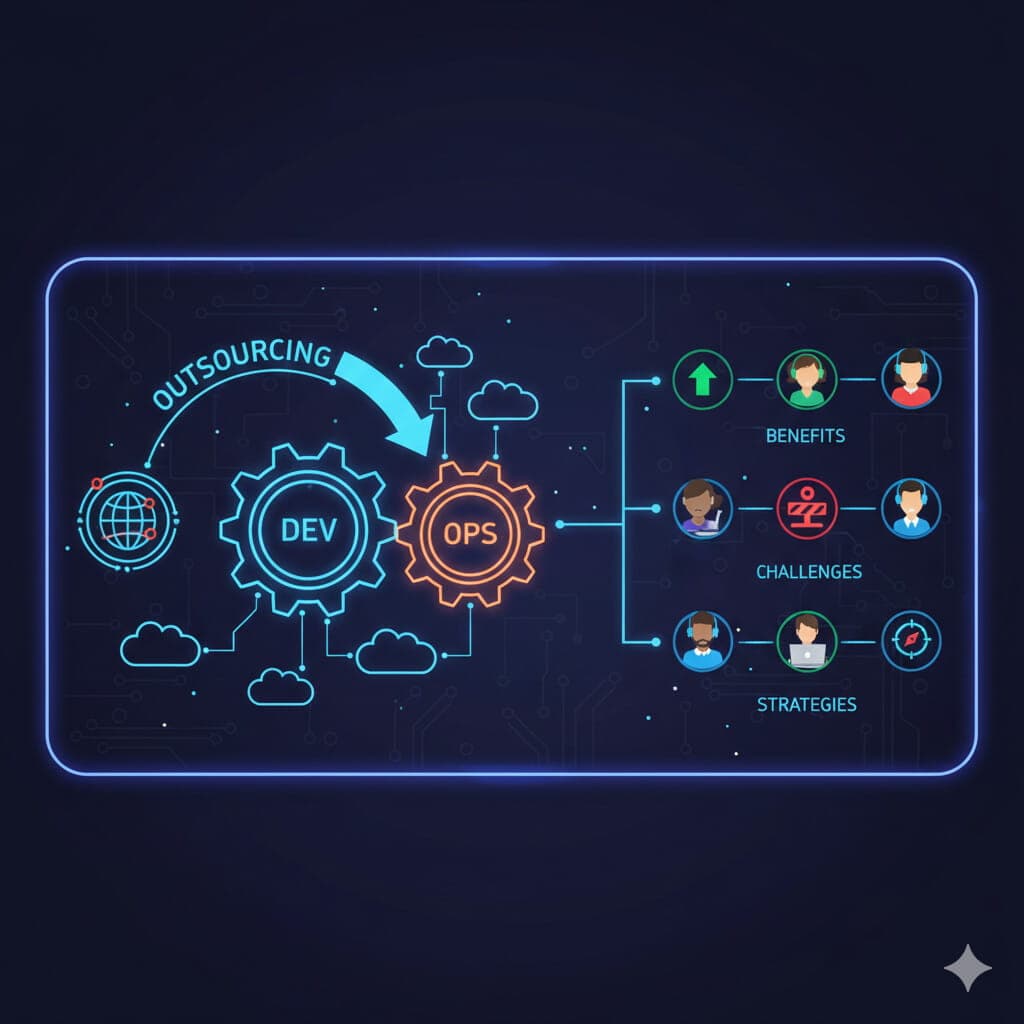
Software development outsourcing is hiring an external team to build or maintain software instead of handling everything internally. Companies delegate specific tasks, whole projects, or ongoing responsibilities to specialized partners, which converts fixed payroll into variable project cost and reaches expertise that local hiring cannot supply on the timeline a roadmap actually needs.
Software projects stall for a small number of recurring reasons: the timeline is fixed, the budget is fixed, and the specific expertise the product needs is not on the team. Hiring closes that gap eventually, but a specialised role takes months to fill and local markets price senior engineers accordingly.
This guide covers what outsourcing involves, when it makes financial and operational sense, how AI has changed the calculus, and how to run partnerships that deliver results instead of creating new problems.
Key takeaways
- The software development outsourcing market is worth $618.38B in 2026, growing 9.6% a year to $977.04B by 2031.
- Rates span roughly 3-5x by region: $100-$200/hr onshore, $50-$100 nearshore, $40-$80 Eastern Europe, $25-$50 offshore.
- Offshore holds 51.85% of the market, but nearshore is the fastest-growing model at 13.95% a year.
- 84% of developers now use AI tools, yet 66% say the output is almost right but not quite. In 2026, judge a partner on AI review discipline, not just hourly rate.
- Pick the engagement model first: project, dedicated team, or staff augmentation decides who carries delivery risk.
What is Software Development Outsourcing?
Software development outsourcing is hiring an external team to build or maintain software. Companies delegate specific tasks, entire projects, or ongoing responsibilities to specialized partners who provide the required skills and capacity, instead of handling everything internally.
Outsourcing converts fixed labor costs into flexible project expenses. You access specialized expertise without permanent hiring commitments or the overhead of maintaining full-time teams for every technical need.
Three primary approaches define how companies structure outsourced work:
Project-Based Outsourcing: You define a complete project with clear deliverables, such as a mobile app, a website rebuild, or an API integration. The partner handles end-to-end delivery, payment ties to milestones, and the engagement concludes when the work is complete.
Dedicated Development Team: You hire a team that works exclusively on your projects, integrating with your processes while employed by the partner. This provides consistent capacity with flexible scaling.
Staff Augmentation: You add individual developers to your existing team. These developers work under your direct management while contracted through the outsourcing company. This suits short-term needs or specialized expertise. A newer variant embeds an engineer inside your systems to ship a live AI result, the embedded AI engineer model.
| Model | How it works | Who manages daily work | Payment | Best for |
|---|---|---|---|---|
| Project-based | Partner delivers a defined scope end to end | Partner | Milestone / fixed price | Clear, stable requirements |
| Dedicated team | Team works only on your product, employed by the partner | Shared | Monthly retainer | Long-term, evolving product (6+ months) |
| Staff augmentation | Individual developers join your existing team | You | Hourly or monthly per person | Short-term gaps, specific skills |
Why Do Companies Outsource Software Development?
Companies outsource mainly for speed, lower cost, and specialized skills. The decision is typically driven by operational flexibility and specialization rather than simple cost reduction, and it removes hiring bottlenecks that slow internal teams.
1. Access global talent without geographic limits
Senior software developers in major US markets command total compensation well into six figures, and at top-tier technology firms considerably more than that.
Outsourcing developers removes geographic boundaries. You reach engineers with experience in AI/ML, blockchain, specific frameworks, or niche technical domains that may be unavailable or prohibitively expensive locally.
2. Reduce fixed costs and create budget predictability
In-house teams carry permanent overhead: salaries, benefits, office space, equipment, licenses, training, management bandwidth. These costs persist regardless of project volume or business cycles.
Outsourcing shifts expenses to variable models. You pay for defined deliverables or specific timeframes. When project needs decrease, costs adjust accordingly without layoffs or severance.
According to Mordor Intelligence, the software development outsourcing market is worth $618.38 billion in 2026 and is projected to reach $977.04 billion by 2031, a compound annual growth rate of 9.6%. The financial impact compounds when you factor in recruitment timelines, onboarding periods and hiring mistakes that cost months of lost productivity.
3. Accelerate time-to-market and scale capacity quickly
Traditional hiring takes months: posting roles, screening, interviews, negotiations, notice periods, onboarding, knowledge transfer. By the time a new hire becomes productive, market windows may close.
Outsourcing partners maintain established teams with existing processes. They start contributing immediately, often within days. For companies facing launch deadlines or competitive pressure, this speed provides tangible advantage.
Need three additional developers for a six-month push? Partners add them without recruitment friction. Project complete? Scale back without severance negotiations.
4. Focus internal teams on strategic priorities
Outsourcing production-heavy work like mobile development, testing, integrations, maintenance frees internal teams to concentrate on competitive differentiators and customer-facing features that define product value.
This separation lets technical leadership optimize team composition. Keep strategic roles internal, and outsource software engineering work that requires scale rather than institutional knowledge.
| Factor | In-house team | Outsourced team |
|---|---|---|
| Time to productive | Months (hire, onboard, ramp) | Days (established teams) |
| Cost structure | Fixed: salary, benefits, overhead | Variable: deliverables or timeframe |
| Scaling | Slow to grow, costly to shrink | Fast in both directions |
| Specialized skills | Limited to local hiring | Global access to niche expertise |
| Institutional knowledge | High, stays internal | Builds over repeat engagements |
| Control | Direct | Depends on model and governance |
What Are the Types of Software Development Outsourcing?
The main types are onshore, nearshore, offshore, and hybrid. These models differ by geography, collaboration intensity, and cost profile, and choosing the right one depends on communication needs, budget constraints, and how closely the external team must integrate with internal workflows.
Onshore outsourcing: same country, higher cost, minimal friction
Onshore means hiring within your own country. Same timezone, shared business culture, identical legal framework and native language fluency eliminate most communication barriers.
Cost is the tradeoff. Onshore rates approach internal hiring costs, which reduces the financial advantage while keeping the convenience. It suits companies prioritising seamless collaboration over savings, or those facing regulatory limits on cross-border data transfer.
Nearshore development: regional proximity, balanced economics
Nearshore means partnering with companies in neighbouring countries or similar timezones. For US companies that usually means Latin America, and for Western European companies it means Eastern Europe.
Nearshore typically costs $50 to $100 per hour, and the timezone overlap enables real-time collaboration. It works well for teams needing frequent synchronous contact: daily standups, pair programming or rapid iteration.
Offshore development: maximum cost advantage, geographic distance
Offshore means engaging teams on distant continents, with India, the Philippines and parts of Asia as primary destinations. Asia offers the lowest rates at $25 to $50 per hour, and savings commonly reach 50 to 70 percent against domestic hiring depending on seniority mix.
The tradeoff is coordination. Large timezone gaps limit real-time interaction, so explicit documentation and structured processes become essential rather than optional.
Hybrid approaches: combining models by project need
Many companies mix models deliberately. Nearshore teams handle core development requiring frequent collaboration, while offshore teams manage testing, maintenance or auxiliary features where asynchronous communication is sufficient.
Offshore accounted for 51.85% of the software development outsourcing market in 2025, while nearshore is the fastest-growing model at a projected 13.95% annual rate through 2031.
| Region / model | Typical rate (per hour) | US timezone overlap | Best for | Main tradeoff |
|---|---|---|---|---|
| Onshore (North America) | $100-$200 | Full | Regulated data, seamless collaboration | Cost close to in-house |
| Nearshore (Latin America) | $50-$100 | Full workday | Daily standups, pair programming, fast iteration | Smaller senior pool than offshore |
| Eastern Europe | $40-$80 | Partial (US mornings) | Strong engineering depth at mid rates | Limited afternoon overlap |
| Offshore (Asia) | $25-$50 | Minimal | Cost-sensitive, async work like QA and maintenance | Needs strong docs and process |
What Software Development Tasks Do Companies Typically Outsource?
Companies outsource production-heavy, specialized, or repeatable work. These are tasks that require scale, specialized expertise, or sustained execution rather than deep institutional context, often tied to technologies that change faster than internal teams can upskill.
Full application development and product builds
End-to-end application development represents the most comprehensive outsourcing engagement. A partner handles everything from requirements analysis through deployment.
This works when internal teams lack capacity to build an entire product, or when specialized platforms require expertise your team doesn't maintain.
Mobile application development across iOS and Android
Mobile development demands platform-specific knowledge like Swift for iOS, Kotlin for Android, or cross-platform frameworks like React Native or Flutter. Not all companies maintain full-time mobile expertise internally.
Outsourcing mobile development to specialists who build apps daily makes economic sense. They maintain current knowledge of platform updates and optimization techniques that generalist teams struggle to sustain.
Quality assurance, testing, and test automation
QA outsources well because it requires dedicated focus, specialised tooling and methodical process, none of which survive deadline pressure inside a feature team.
Application maintenance, support, and technical debt management
Ongoing maintenance like bug fixes, minor updates, dependency patches, security updates consumes significant development capacity without producing new features.
Outsourcing maintenance frees internal developers to focus on feature development and innovation. External teams handle routine updates and incremental improvements that keep products stable.
Specialized technologies: AI/ML, blockchain, cloud infrastructure
Emerging technologies require expertise that takes years to develop internally. AI/ML, blockchain, cloud architecture, and cybersecurity are domains where specialized knowledge delivers disproportionate value. For companies exploring Machine Learning implementations or needing specialized DevOps capacity, partnering with specialists who maintain deep domain knowledge beats building these capabilities from scratch.
How is AI Changing Software Development Outsourcing in 2026?
In 2026, AI has shifted outsourcing toward smaller, senior teams. It has changed both what you should outsource and who you should outsource to, because AI-assisted coding tools like GitHub Copilot, Cursor, and Claude Code let fluent engineers ship measurably faster, shifting demand away from large, junior-heavy offshore pyramids. The boilerplate that used to justify a big squad is increasingly written by AI under human review.
Four shifts matter for buyers in 2026:
- Team composition is going senior. Because AI handles routine code, the offshore teams worth hiring are leaner and weighted toward engineers who can direct and review AI output, not just produce it.
- Data and MLOps are the scarce skills. As machine learning moves from pilots to production, demand has shifted toward data engineering, pipelines, and MLOps talent, much of it sourced offshore.
- AI is standard, and review discipline is the differentiator. Industry data shows 84% of developers now use or plan to use AI tools, up from 76% a year earlier, yet 66% say AI output is often almost right but not quite, and 45% lose time debugging it. The partners worth hiring are the ones with human review gates, not those shipping AI output unchecked.
- The operating model is shifting. Buyers increasingly treat offshore delivery as a strategic capability rather than cheap labor, and many now prefer partners that pair software development with operational and AI-governance capability rather than code alone.
The practical takeaway: in 2026, judge an offshore software development company on how disciplined its AI workflow is, not just its hourly rate. A cheap team shipping unreviewed AI code costs more than it looks.
How Much Does Software Development Outsourcing Cost?
Rates run about $25 to $200 per hour depending on region. Total cost also varies by engagement model and project complexity, so understanding both visible rates and hidden cost drivers is essential to estimating true total cost of ownership.
Regional rate variations create 3-5x cost differences
North American onshore developers typically charge $100-$200 per hour. Nearshore Latin American developers range $50-$100 per hour. Offshore Asian developers cost $25-$50 per hour. Eastern European rates fall between $40-$80 per hour.
Treat these as planning ranges rather than quotes. Rates move with seniority, stack and demand, and rates for AI, data and security roles have risen faster than the rest of the market.
Enterprise applications are the most expensive type of software project to outsource, costing $100,000-$500,000 USD. Simple mobile apps or websites may cost $10,000-$50,000. Complex platforms requiring custom architecture easily exceed $500,000.
| Project type | Typical range |
|---|---|
| Simple app or website | $10,000-$50,000 |
| Enterprise application | $100,000-$500,000 |
| Complex custom platform | $500,000+ |
These bands assume defined requirements. A project that doubles as the discovery process lands outside them, which is why scoping work before requesting quotes pays for itself.
Understanding pricing models: fixed, hourly, and dedicated team
Fixed-Price Contracts: Total project cost agreed upfront based on defined scope. Suitable for projects with clear, stable requirements.
Time and Materials (Hourly): Payment based on actual hours worked. Provides flexibility for evolving requirements but requires active oversight to prevent budget overruns.
Dedicated Team (Monthly Retainer): Fixed monthly cost for a dedicated team working exclusively on your projects. Combines budget predictability with scope flexibility. Most effective for long-term engagements lasting six months or more.
Hidden costs that impact total project economics
Listed rates rarely capture complete project costs:
Project management and coordination commonly account for around 10 to 15% of total project cost, and quality assurance and testing add roughly 20 to 30% depending on coverage and automation depth. Both vary by engagement model, so confirm what is included in a quote rather than assuming.
Upfront investment in requirements definition increases initial cost but reduces downstream rework and delivery risk.
How to Choose the Right Software Development Outsourcing Partner
Judge a partner on delivery record, communication, and security. Selecting one requires evaluating more than technical capability, because proven delivery history, communication discipline, security posture, and process maturity determine whether an engagement succeeds or creates long-term risk. This section covers the essentials; for the full scorecard and due-diligence framework, see our deeper guide on how to choose a development outsourcing partner.
1. Evaluate technical expertise through portfolio and references
Request detailed case studies showing projects similar in scope, technology, and complexity to your needs. Contact references directly. Ask specific questions about communication responsiveness, deadline adherence, and code quality.
Have senior developers from both teams discuss architecture approaches and implementation strategies. Surface-level discussions indicate limited depth. When you need a specific stack, ask to speak with the actual full-stack developers who would be assigned, not just the account lead.
Review actual code samples. Code quality, documentation standards, and architectural decisions visible in real work tell more than marketing materials.
2. Assess communication capabilities and process maturity
Communication failures sink outsourcing relationships more frequently than technical shortcomings. Evaluate responsiveness, clarity, and proactive communication during the sales process.
Ask about development processes, documentation standards, and project management tools. Mature partners maintain established workflows and use standard collaboration platforms (Jira, GitHub, Slack).
Request information about team composition, experience levels, and turnover rates. High turnover creates continuity problems.
3. Verify security practices and intellectual property protection
Request evidence of security certifications (ISO 27001, SOC 2), development security practices, and infrastructure protections.
Contracts must clearly establish IP ownership. Ensure work product, code, documentation, and all deliverables transfer to you upon completion.
For regulated industries or sensitive data, verify compliance with relevant standards (HIPAA, GDPR, PCI-DSS).
4. Start with limited pilot projects before major commitments
Start with smaller, lower-risk projects to validate capabilities, communication patterns, and cultural fit before committing to major initiatives.
Pilot projects reveal how partners handle unclear requirements, deadline pressure, and unexpected challenges. Successful pilots build confidence. Failed pilots cost far less than discovering problems mid-way through critical projects.
What Should Be in an Outsourcing Contract?
Seven clauses carry most of the weight in an outsourcing contract. Contract terms decide what happens when something goes wrong, which is the only moment they matter.
IP assignment. Ownership of code, documentation and deliverables should transfer on creation rather than on final payment. The difference becomes expensive during a payment dispute.
Named key personnel. Specify who is assigned and require written notice before replacement. Without it, the engineers you interviewed can be swapped for whoever is available.
Acceptance criteria. Tie payment milestones to a written definition of done rather than to elapsed time or effort.
Change control. Define how scope additions are proposed, priced and approved. Ambiguity here is the most common single source of budget overrun.
Security and data terms. Cover access levels, data residency, subprocessors and breach notification timing, particularly where personal data is involved.
Exit and handover. Specify what is delivered at the end: source, credentials, documentation, runbooks and architecture diagrams, and whether handover is billable.
Liability and warranty. Include a defect remediation window after delivery so bugs found post-launch have a defined owner.
Negotiate the exit terms while both sides still want the deal. The alternative is negotiating them during a dispute, from a much weaker position.
What Are Common Challenges in Software Development Outsourcing?
Most failures come from communication, quality, and governance gaps. These predictable issues, rather than technical limitations, create rework, delays, and loss of control if not addressed early.
Communication Barriers Create Misunderstanding and Rework
Language differences, cultural communication styles, and timezone gaps create opportunities for misalignment.
Prevention: Invest heavily in upfront documentation. Write detailed user stories, create visual mockups, define acceptance criteria explicitly. Schedule regular video calls rather than relying solely on written communication.
Quality Concerns When Standards Aren't Explicitly Defined
Code quality, testing thoroughness, and documentation completeness may not match internal standards if expectations remain implicit.
Prevention: Establish explicit quality standards in contracts. Define code review processes, automated testing requirements, documentation expectations, and performance benchmarks.
Hidden Costs and Scope Creep Exceed Initial Budgets
Projects frequently exceed initial estimates when requirements evolve or specifications prove incomplete.
Prevention: Build 15-20% contingency into project budgets. Establish formal change request processes defining how scope additions are evaluated, priced, and approved.
Timezone Differences Delay Communication and Decision-Making
Significant timezone gaps mean questions raised today get answered tomorrow. This introduces day-long delays into every decision cycle.
Prevention: Choose partners with meaningful timezone overlap for projects requiring frequent interaction. Embrace asynchronous communication for offshore teams through detailed written updates and comprehensive documentation.
Loss of Control Over Technical Decisions and Architecture
Without proper governance, architectural direction can drift from intended patterns.
Prevention: Retain architectural authority internally. Define system architecture, technology stack, and integration patterns before work begins. Require architectural review checkpoints at project phases.
Software Development Outsourcing Best Practices for Success
Successful outsourcing depends on execution discipline rather than vendor promises. Clear requirements, structured communication, staged delivery, and enforced ownership boundaries consistently separate high-performing partnerships from failed ones.
1. Define clear requirements before engagement begins
Ambiguous requirements guarantee expensive rework cycles. Invest time upfront creating detailed specifications, user stories, acceptance criteria, and visual designs.
Document not just what to build, but why. Context about business goals and user needs helps external teams make better implementation decisions.
2. Establish communication protocols and regular cadences
Define meeting schedules, reporting formats, escalation paths, and communication tools at project start. Daily standups maintain alignment. Weekly demos show progress. Bi-weekly retrospectives improve process continuously.
Use collaborative tools that provide transparency like shared task boards, version control systems, documentation wikis.
3. Implement staged deliveries with defined acceptance criteria
Break projects into phases with clear deliverables and acceptance criteria at each stage. This creates natural checkpoints for evaluating progress and adjusting direction.
Staged delivery reduces risk. Problems discovered in early phases cost far less to correct than issues found after months of misaligned work.
4. Maintain knowledge transfer and documentation standards
Outsourced work eventually needs internal maintenance. Require code comments, architecture documentation, deployment procedures, and troubleshooting guides as standard deliverables.
Schedule overlap time between external team and internal maintainers. Live knowledge transfer through pair programming proves more effective than documentation alone.
5. Build long-term partnerships rather than transactional relationships
Partners who understand your business context, technical standards, and product vision deliver better results with less oversight. This institutional knowledge develops through repeated collaboration.
For companies requiring reliable Frontend Development Services or specialized technical capabilities, establishing long-term partnerships with vetted development teams creates sustainable competitive advantage.
How Do You Start Outsourcing Software Development?
Six steps take you from decision to a live engagement. You commit to nothing you cannot reverse along the way.
- Write a one-page brief. Goals, constraints, timeline, stack and what is explicitly out of scope. If you cannot write acceptance criteria for it, the work is not ready to be outsourced yet.
- Decide the engagement model first. Project, dedicated team or staff augmentation changes who manages daily work and who carries delivery risk, and it changes which partners are even relevant.
- Shortlist three to five partners whose case studies match your scope, technology and company size, rather than whoever ranks highest for your search. If vetting on your own is the bottleneck, a matching service like Vetted Outsource narrows the field to pre-screened partners.
- Interview the delivery engineers, not the sales team. Ask the people who would actually be assigned to discuss architecture and walk through past work.
- Run a paid pilot. Two to four weeks, a real deliverable, your own process and repository, with success criteria written before it starts.
- Scale on evidence. Compare pilot results against your criteria, then commit to a longer engagement or stop. A failed pilot costs weeks. A failed twelve-month contract costs a roadmap.
The step teams skip under deadline pressure is the pilot, and it is the one that saves the most.
Why Vetted Outsource Delivers Reliable Development Partnerships
Finding capable development partners requires significant time, research, and risk. Most companies lack the expertise to evaluate technical capabilities accurately or the network to identify reliable options across global markets.
Vetted Outsource solves this problem. We pre-screen development companies across technical competency, delivery history, communication effectiveness, and cultural compatibility. Partners are evaluated based on technical depth, delivery history, communication standards, and security practices.
Companies using our service skip months of vendor evaluation, avoid the cost of failed partnerships, and start projects with teams proven to execute. We match your specific needs (technology requirements, budget constraints, and timeline expectations) with partners that demonstrate relevant capability.
Our screening process evaluates portfolio quality, checks references thoroughly, assesses security practices, and validates development processes before we recommend anyone. You work with companies we trust based on demonstrated performance, not marketing claims. Whether you need a full-stack team, specialized React expertise, or comprehensive QA Engineers, Vetted Outsource connects you with partners who have proven themselves on similar engagements.
Software development outsourcing works when companies treat it as an execution model, not a shortcut. Clear scope definition, disciplined partner selection, and retained technical ownership determine outcomes more than geography or hourly rates. Teams that validate partners through evidence and staged delivery consistently achieve faster execution with lower long-term risk.