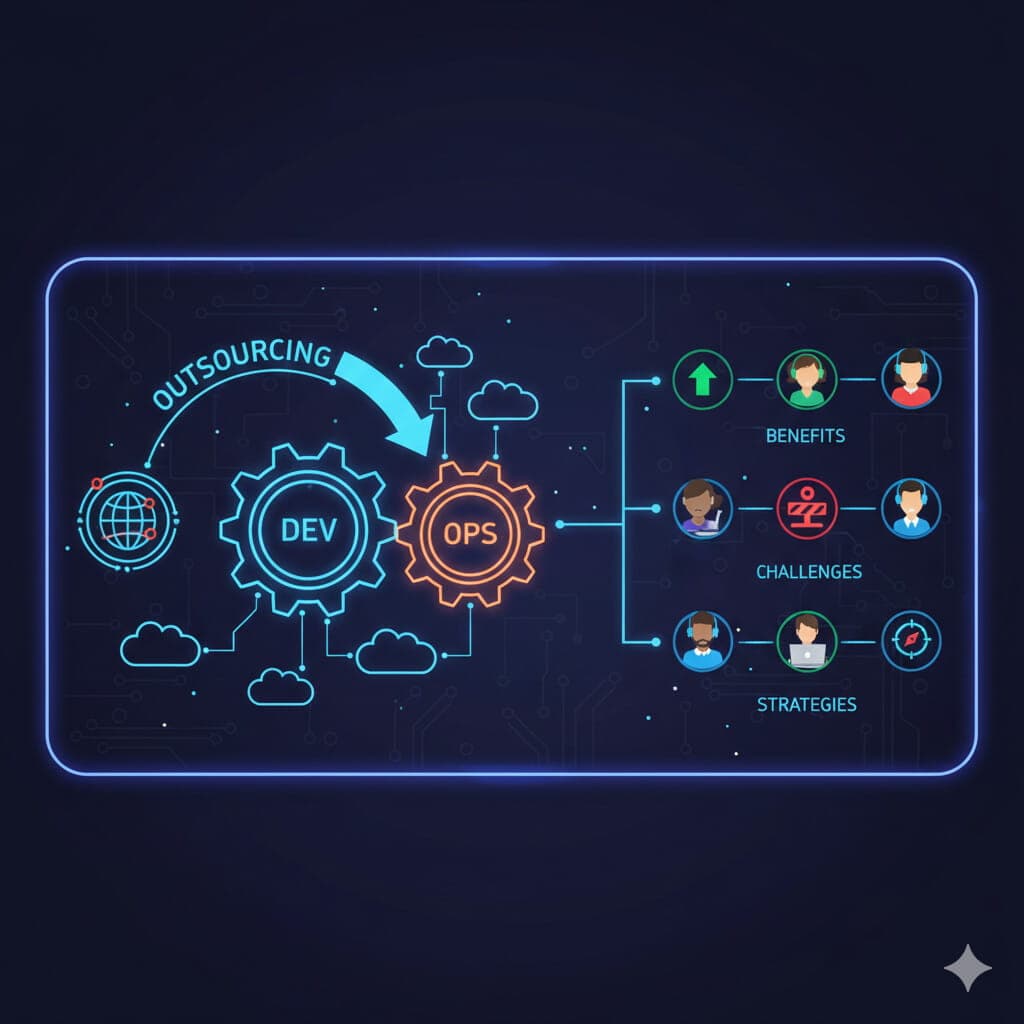
Staff augmentation places contracted engineers inside a team you still direct, with the provider carrying employment, payroll and benefits. It is the model to reach for when the constraint is hands rather than direction, and the engagement has a foreseeable end. Cost is no longer the main reason buyers choose it; access to scarce skills and delivery speed are.
The model contracts specific skills directly into your existing team and process, so architecture, priorities and release decisions stay internal while capacity moves. This guide covers what it costs, how the geographic options compare, how AI is reshaping demand, where the legal exposure sits, and how to prove an engagement paid for itself.
Key takeaways
- The global IT outsourcing market reached $638.65 billion in 2026 and is projected to hit $752.08 billion by 2031 at a 3.32% CAGR, according to Mordor Intelligence.
- Cost is no longer the main driver. Deloitte's Global Outsourcing Survey data shows cost reduction as the primary motive fell from 70% in 2020 to 34% in 2026, replaced by talent access and speed to market.
- Placement from an established bench is measured in weeks, against the months a specialized permanent search typically takes.
- Benefits alone accounted for 30.1% of total compensation for US private industry workers in March 2026, per BLS Employer Costs for Employee Compensation. That is overhead a rate-based engagement does not carry.
- AI has moved augmentation demand toward senior and specialist profiles, because coding assistants absorb routine implementation while review, architecture and integration judgment stay scarce.
- The real risk is not quality, it is worker classification and co-employment exposure, governed by IRS guidance in the US, IR35 in the UK, and Directive 2008/104/EC in the EU.
What is staff augmentation?
Staff augmentation in software teams is a contracting model in which an organization temporarily adds external professionals with specific skills to its existing team. The augmented staff work inside the client's processes, tools and management structure while remaining employed by a third-party provider, usually on a time and materials basis.
That last detail is what separates it from every adjacent model. In staff augmentation, the client assigns tasks and supervises the work, whereas in project outsourcing a supplier delivers a defined outcome under its own management. Ownership of architecture, backlog priority and release decisions never leaves the internal team.
The model is not new and it is not confined to software. Public sector procurement has used the term for decades, typically framed as temporary technology staffing for defined initiatives with named roles such as developers, analysts and security specialists.
How common is it?
Contract labour is a large and measurable share of the workforce even though staff augmentation itself is not tracked as a standalone statistic. US Bureau of Labor Statistics figures from the July 2023 Contingent Worker Supplement put 4.3% of employed people in contingent jobs, with independent contractors at 7.4%, temporary help agency workers at 0.6% and workers supplied through contract firms at 0.5%.
On the demand side, current industry reporting indicates 46% of businesses already outsource technology services and a further 42% intend to start within twelve months. Cybersecurity and IT infrastructure now tie as the most outsourced functions at 72%, a sharp reversal for cybersecurity, which sat near the bottom of that list as recently as 2023.
How does staff augmentation work, step by step?
The sequence below is what a well-run engagement looks like from first requirement to roll-off. Skipping steps two and five is where most disappointing engagements go wrong.
- Define the gap. Translate the backlog or roadmap into named roles, seniority levels, stack requirements and an expected engagement length. Vague requirements produce vague candidates.
- Qualify providers. Assess talent network depth, vetting methodology, replacement guarantees, IP and confidentiality terms, and references from companies of similar size in your sector.
- Evaluate candidates directly. Run your own technical interview. A provider's screening is a filter, not a substitute for your judgment on fit and communication.
- Onboard deliberately. Provision repository, environment and tooling access under least privilege, assign an internal buddy, and give a first task that is small, real and reviewable.
- Manage inside your own ceremonies. Augmented engineers attend standups, retros and planning, and their work passes the same code review and definition of done as everyone else's.
- Scale or convert. Adjust composition as the roadmap moves, and negotiate conversion terms before the engagement starts rather than after you decide you want to keep someone.
Tip: Agree the replacement clause in writing before signing. The useful version specifies a response window in business days, not "reasonable efforts."
What are the main benefits of staff augmentation?
Eight benefits, but they reduce to two ideas: you get capacity faster than hiring allows, and you can reverse the decision without severance or morale cost. Everything else follows from those. The narrow-skill access, the lower hiring risk, the reduced admin burden and the knowledge inflow are all consequences of renting rather than employing.
1. Speed to a productive engineer
Recruiting a specialized permanent hire is measured in months, running from requisition approval through sourcing, panels, offer and notice period. An established provider draws from a pre-screened bench, so equivalent capacity arrives in weeks. The gain is not only calendar time, it is the roadmap slippage you avoid while waiting.
2. Access to skills you cannot justify hiring permanently
Some capabilities are needed intensely and briefly. A tokenization feature needs Solidity depth for eight weeks, a SOC 2 push needs a compliance-literate security engineer for a quarter, and a migration needs a database specialist once. Hiring permanently for a temporary peak creates a role you will later have to redefine or eliminate.
3. Variable cost instead of fixed cost
Permanent headcount converts into a fixed obligation carrying benefits, payroll tax, equipment, recruitment fees, ramp time and eventual severance. Augmentation converts that into a rate you can stop paying at the end of an agreed period. The full comparison is in the cost section below.
4. Elasticity without layoffs
Capacity can rise for a launch and fall afterwards without redundancy processes, severance cost or the morale damage that follows a visible reduction. That matters most for seasonal businesses, pre-revenue product bets and anything funded on a defined tranche.
5. Reduced hiring risk
An engagement is an extended, evidence-based interview conducted on real deliverables rather than on whiteboard performance. If the fit is wrong you exercise a replacement clause in days. If it is right, you have already validated technical work, collaboration and reliability before making an offer.
6. Lower administrative load
The provider carries payroll, tax compliance across jurisdictions, benefits administration and employment contracts. For a company without mature HR infrastructure, that removes a real operational burden, though it does not remove the classification risk covered further down.
7. Knowledge inflow
Engineers who have shipped the same pattern at four other companies bring calibration your team cannot generate internally. Pairing, architecture review and design critique are the mechanisms that turn that into retained capability, and they only happen if you schedule them.
8. Optionality on new bets
Assembling a three-person team to test a market hypothesis for ten weeks is a cheap experiment. Restructuring permanent headcount to do the same thing is not. Augmentation lets you take more shots without making each one an organizational commitment.
How is AI changing the staff augmentation model in 2026?
Artificial intelligence has not reduced demand for augmented engineering capacity, it has moved it. The work that a junior contractor used to absorb, meaning boilerplate, test scaffolding, first-draft CRUD and routine refactors, is now substantially handled by coding assistants. What remains scarce is the judgment to specify, review and integrate that output safely, and that is exactly the profile augmentation buyers are now requesting.
The demand curve moved upward, not downward
The scarce resource is no longer the ability to produce code, it is the judgment to specify, review and integrate what tooling produces. That judgment sits at the senior end of the market, which is the hardest end to hire permanently and the easiest to rent for a defined period. Augmentation therefore gets more useful as tooling improves, not less.
The practical consequence for buyers is that the cheapest augmented engineer is now frequently the most expensive decision. A mid-level contractor producing AI-assisted code without architectural context generates review load rather than throughput, and that review load lands on the senior engineers whose time you were trying to protect.
Which roles buyers are actually asking for
| Declining demand | Rising demand |
|---|---|
| Generalist junior developers | AI and ML engineers, MLOps |
| Manual QA testers | QA automation and evaluation engineers for AI systems |
| Basic CRUD implementation | LLM integration and RAG engineers |
| Standalone frontend production work | DevSecOps and cloud cost optimization |
| Documentation and boilerplate | Data engineers and platform engineers |
What changes in how you run the engagement
Four practical adjustments separate teams getting value from AI-era augmentation from teams accumulating review debt.
- Ask about AI tooling in the interview. Whether a candidate uses assistants matters less than whether they can explain what they rejected and why. That answer tells you more about seniority than any algorithm question.
- Write AI usage into the contract. Specify which assistants are permitted, whether your code may be sent to third-party models, and who owns and warrants generated output. Most 2024-era master agreements are silent on this, which is a gap your security reviewer will eventually find.
- Tighten review, do not loosen it. Higher output volume with unchanged review capacity is how defect rates climb quietly. Budget review time as a percentage of added capacity, not as a fixed allocation.
- Expect outcome-based pricing pressure. Buyers are increasingly moving from pure time and materials toward deliverable-linked structures, since hours are a weaker proxy for value once tooling multiplies individual output.
A caution on AI-assisted vetting
Providers now screen with matching engines that score candidates against skill graphs and contribution history. That speeds up shortlisting, and it does not replace your own technical interview. A model can rank a profile against a job description, but only your team can judge whether someone will function inside your codebase, your review culture and your escalation habits.
Tip: ask any provider two questions. What proportion of your shortlist is machine-ranked, and who performs the human validation step? A vendor that cannot answer both is selling you a database query.
How much does staff augmentation cost in 2026?
Cost moves with four things: seniority, region, engagement length, and who carries the employment overhead. Regional bands give you a starting range, but they answer the wrong question. What decides whether an engagement is worth it is total cost of ownership against the permanent hire you did not make, which includes benefits, recruitment, equipment and the months of ramp you avoided.
Indicative rate bands
Published rate figures for this market come almost entirely from vendor blogs quoting each other, so the table below is deliberately left blank rather than filled with numbers that cannot be traced to a source. Fill it from your own current provider quotes, which makes it more accurate than anything your competitors have published and turns it into original data.
| Region | Mid-level hourly | Senior hourly | Typical overlap with US Eastern |
|---|---|---|---|
| South and Southeast Asia | your quoted range | your quoted range | 0 to 2 hours |
| Eastern Europe | your quoted range | your quoted range | 2 to 4 hours |
| Latin America | your quoted range | your quoted range | 5 to 8 hours |
| North America onshore | your quoted range | your quoted range | Full |
Total cost of ownership against a permanent hire
Hourly rate comparisons flatter permanent hiring because they ignore everything sitting on top of base salary. The line items below are what an honest comparison includes.
| Cost component | Permanent employee | Augmented professional |
|---|---|---|
| Base compensation | Salary | Included in rate |
| Benefits and payroll tax | 30.1% of total compensation, US private industry, BLS March 2026 | Carried by provider |
| Recruitment | Agency fee charged as a share of first-year salary | Included or a flat placement fee |
| Time to full productivity | Months | Weeks |
| Equipment and workspace | Employer cost | Usually provider cost |
| Training and retention programs | Ongoing | Not applicable |
| Exit cost | Notice period plus severance | End of agreed term |
| Commitment | Indefinite | Fixed term |
Savings claims in this category are usually calculated on hourly rate against base salary, which is not a like-for-like comparison. BLS Employer Costs for Employee Compensation put benefits at 30.1% of total compensation for US private industry workers in March 2026, and that is before recruitment fees, equipment and ramp time. Run your own comparison on a fully loaded annual figure.
Nearshore, offshore or hybrid: which model fits?
The table below is really about prerequisites, not geography. Nearshore asks only that you run standard agile practice. Offshore asks for written specs, automated tests and clear acceptance criteria to already be in place. Hybrid asks for an explicit handoff protocol between the two. Read the bottom row first and work upward.
| Factor | Nearshore | Offshore | Hybrid |
|---|---|---|---|
| Typical regions | Latin America for US buyers, Iberia and Eastern Europe for EU buyers | South Asia, Southeast Asia, parts of Eastern Europe | Both, split by role |
| Real-time overlap | 5 to 8 hours | 0 to 3 hours | Overlap where it matters |
| Cost advantage | Moderate | Highest | Balanced |
| Best-fit roles | Product, design, frontend, DevOps, anything requiring frequent conversation | Backend, QA automation, data engineering, well-specified implementation | Nearshore for collaboration-heavy roles, offshore for depth |
| Main risk | Smaller talent pools in niche stacks | Coordination cost if async discipline is weak | Managing two provider relationships |
| Prerequisite | Standard agile practice | Written specs, automated tests, clear acceptance criteria | Explicit handoff protocol |
Offshore models fail on process, not on talent. If your acceptance criteria live in someone's head and your test suite is thin, the timezone gap will surface that weakness within two sprints. Fix the documentation discipline first, then extend the timezone spread.
Staff augmentation vs outsourcing vs dedicated team vs hiring
The four differ on one axis: how much of the management burden you keep. Augmentation leaves it entirely with you. A dedicated team shares it with a vendor lead. Project outsourcing transfers it. Permanent hiring keeps it indefinitely, along with the employment obligation. Choose by how much you intend to manage, not by the rate card.
| Staff augmentation | Project outsourcing | Dedicated team | Permanent hire | |
|---|---|---|---|---|
| Who manages daily work | You | Vendor | Vendor lead, your priorities | You |
| Who owns scope | You | Contract | You | You |
| Pricing model | Time and materials | Fixed price or milestone | Monthly per seat or squad | Salary plus benefits |
| Ramp time | Fastest | Slower, vendor-side setup | Moderate | Slowest |
| Ideal duration | 3 to 18 months | Defined deliverable | 12 months or more | Indefinite |
| Requires internal tech leadership | Yes | No | Partly | Yes |
| Flexibility to change direction | High | Low | Medium | Low |
| Best when | You know what to build and lack hands | Scope is stable and unambiguous | You need a whole squad and lack coordination capacity | The role is core and permanent |
If you are still weighing engagement structures against each other, the deeper comparison sits in our guide on choosing an outsourcing partner.
When should you use staff augmentation?
The model fits when three things are true at once: the work is specified well enough to write acceptance criteria, someone internal can review what comes back, and the need has an end date. Miss any one of those and augmentation amplifies the gap rather than filling it, because you are adding output without adding the judgment to check it.
Use this checklist. Four or more yes answers means the model fits.
- The work is defined well enough to write acceptance criteria today
- You have an internal technical lead who can review code and answer questions
- The capacity need has a foreseeable end, roughly 3 to 18 months
- The skill gap is specific rather than general
- Your development workflow already exists and is documented
- Delay carries a measurable business cost
Typical fits include MVP builds of three to six months, platform migrations of six to twelve months, seasonal surges of two to four months, technical debt initiatives, and short specialist engagements in security, data engineering or machine learning.
Sourcing is its own discipline once you have decided, and the practical screening steps are covered in our guide on how to find vetted developers.
When should you not use staff augmentation?
The failure conditions are specific and worth taking seriously. Augmentation does not work when the requirement is permanent and core to the product, when scope is exploratory enough to need constant renegotiation, when the data cannot lawfully sit with a third-party processor, or when the absence of internal technical leadership means nobody can tell you whether the work is good.
This section matters more than the benefits list, because the model has clear failure conditions.
- You have no internal technical leadership. Augmented engineers need direction. Without it you are paying senior rates for people waiting on decisions. Consider a dedicated team or a fractional CTO instead.
- The requirement is genuinely permanent and core. Domain logic that defines your product belongs with people who are staying.
- Scope is undefined and exploratory in a way that needs constant renegotiation. Time and materials with no acceptance criteria is how budgets drift.
- The work touches data you cannot lawfully expose to a third-party processor. Some regulated workloads need employees with specific clearances or residency.
- You are trying to replace, rather than supplement, your engineering organization. Over-dependence creates fragility that surfaces the moment a key contractor rolls off.
What legal and compliance risks apply?
The exposure that matters is co-employment. Direct an augmented engineer exactly as you would an employee, for long enough, and a tax authority can reclassify them as one, leaving you with back-taxes, benefits liability and penalties. Keep the provider visible in the management chain, cap engagement length, and have counsel review the contract against your jurisdiction's test.
This is where most vendor-published content goes quiet, and it is a genuine buyer concern.
Worker classification. The IRS treats employee versus independent contractor status as a facts-and-circumstances assessment centred on the right to direct and control the work, with no single determining factor. Since staff augmentation involves the client directing daily work, the arrangement sits close to the line by design. Contract with an entity that employs the worker, and document the relationship carefully.
Co-employment and joint employment. EEOC enforcement guidance applies equal employment law to contingent workers placed by staffing firms, meaning client conduct is not automatically insulated by the intermediary. Train managers accordingly and keep HR processes for augmented staff routed through the provider.
UK off-payroll rules. IR35 aims to ensure workers supplying services through intermediaries pay broadly the same income tax and National Insurance as employees where the underlying relationship would otherwise be employment. Status determination responsibility sits with the client for medium and large organizations.
EU temporary agency work. Directive 2008/104/EC sets a framework for the working conditions of temporary agency workers, including a principle of equal treatment with directly employed staff on core conditions. National implementations differ, so verify per country.
Data protection. Where augmented staff access personal data, the controller-processor contract requirements apply. Grant least-privilege access, log it, and execute NDAs and IP assignment before the first repository invite.
Practical rule: legal review of the master services agreement should happen once, before the first engagement, and then be reused. Companies that skip it usually discover the gap during a customer security review, at the worst possible moment.
How do you onboard an augmented engineer?
Phase 1: define
Name the roles, seniority, stack and duration. Set a rate ceiling and total budget. Decide who manages the augmented staff day to day and how performance will be judged.
Phase 2: select the provider
Compare at least three on vetting method, bench depth in your stack, replacement terms, IP and confidentiality language, and references. Ask specifically what happens in week two if the fit is wrong.
Phase 3: evaluate candidates
Run a technical interview appropriate to the role, whether that is a scoped coding exercise, an architecture conversation or a portfolio review. Assess written communication explicitly, since most of the collaboration will be written.
Phase 4: onboard
Provision access under least privilege, assign an internal buddy, run a codebase walkthrough, and set expectations on hours, response times and documentation standards. Budget one to two weeks and treat it as investment, not overhead.
Phase 5: manage and measure
Track delivery and quality from week one, gather feedback from the permanent team early, and document outcomes so the next engagement starts from evidence rather than from instinct.
What goes wrong in augmentation engagements?
| Challenge | What it looks like | Mitigation |
|---|---|---|
| Weak team integration | Augmented staff excluded from decisions and social context | Include them in ceremonies and team channels, give them named ownership of components |
| Knowledge leaving at roll-off | Context lives in one contractor's head | Mandatory architecture decision records, pairing, runbooks, overlap period before exit |
| Timezone friction | Decisions blocked for a full day | Require four hours of overlap, define escalation paths, record key meetings |
| Variable quality | Skills below the interview impression | Two to four week probationary checkpoint, exercise replacement rights fast |
| Security exposure | Broad repository access granted on day one | Least privilege, audit logging, signed NDA and IP assignment before access |
| Over-dependence | Critical systems understood only by contractors | Keep permanent staff in leadership and core domain roles, enforce shared ownership |
How do you measure staff augmentation ROI?
Define the baseline before the engagement starts, otherwise every result is arguable afterwards.
Delivery metrics: features or story points completed per sprint, deployment frequency, lead time from commit to production, and change in cycle time against the pre-engagement baseline.
Quality metrics: escaped defect rate, test coverage change, and whether technical debt increased or decreased during the engagement.
Financial metrics: fully loaded cost per delivered feature against your permanent team baseline, weeks to first meaningful contribution, and total cost of ownership including the management time the engagement consumed.
Team metrics: permanent team feedback on collaboration, documented knowledge transfer, and conversion rate of high performers into permanent roles.
A useful single question at the end of every engagement: did lead time improve while escaped defects stayed flat or fell? If yes, scale the pattern. If no, the problem is usually your intake process, not the individuals.
Ready to scale your team?
VettedOutsource matches companies with pre-screened engineers who integrate into your existing process, your tools and your standards. Tell us the role, the stack and the timeline, and we will shortlist candidates you can interview directly, with replacement terms agreed in writing before anyone starts.