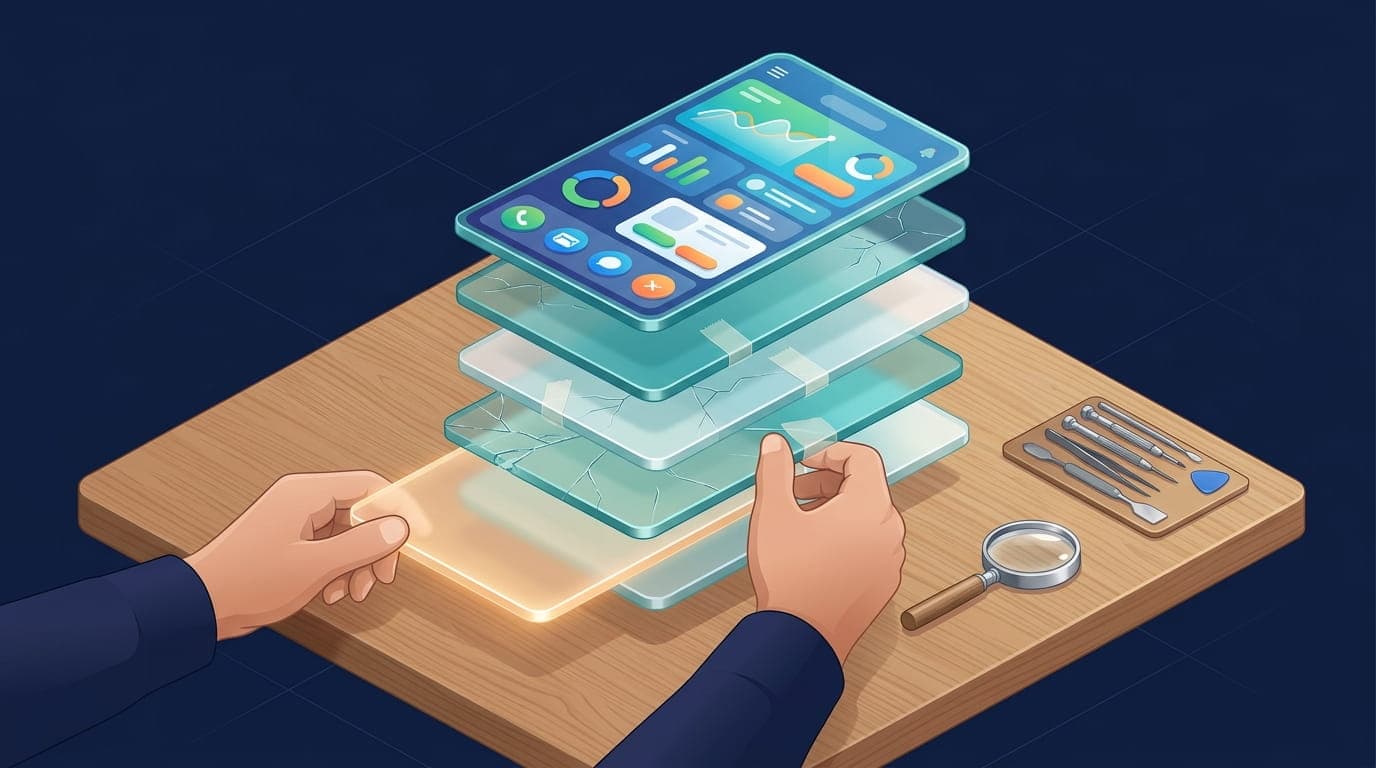
The things you must control when outsourcing a mobile app are the store accounts, the signing keys, the native versus cross-platform decision, and named responsibility for data disclosures. Everything else is safely delegated. Those four are not, because losing any of them costs you the app's identity, its architecture, or its ability to pass review.
A company can outsource a mobile app successfully and still end up unable to ship an update, because the app signing key sits in a vendor's password manager and the Play Console account is registered to the vendor's business entity. That failure has nothing to do with code quality, and no amount of vendor vetting prevents it.
Mobile is the one category where outsourcing carries structural risks that web projects do not, because two platform owners impose their own rules, their own deadlines and their own account ownership model on top of your contract. This guide covers what those are and what you must hold rather than delegate.
Key takeaways
- Own the accounts and the keys. The App Store Connect and Google Play accounts should be registered to your legal entity, and signing keys should never live only with a provider.
- Maintenance is not optional and never reaches zero. Google Play requires new apps and updates to target Android 16, API level 36, from August 31, 2026, with extensions available to November 1.
- Falling behind is invisible. Apps that stop meeting the target API floor do not get removed, they stop being available to new users on newer devices, so the damage shows up in acquisition rather than in an alert.
- Store review sits between your team and your users. No provider controls it, so treat submission dates as estimates and never schedule a marketing launch on an unreleased build.
- The native versus cross-platform choice belongs to you. Providers recommend what their bench knows, which is a legitimate bias but still a bias.
What makes mobile app development outsourcing different?
On the web you control distribution. You deploy when you decide, you roll back when you need to, and no external party approves the change. Mobile inverts that, because Apple and Google sit between your build and your users, with review processes, policy rules and annual platform requirements that your contract cannot override.
Four consequences follow, and they should shape the engagement rather than appear as surprises later.
| Web project | Mobile project |
|---|---|
| You deploy on your own schedule | Store review gates every release |
| Rollback is a pipeline action | Rollback means shipping a new build through review again |
| Browser support degrades gracefully | Target API deadlines are hard cutoffs with dates |
| Hosting accounts are obviously yours | Store accounts and signing keys are often quietly set up by the vendor |
| Maintenance is optional after launch | Maintenance is mandatory to stay distributable |
That last row is the one that breaks budgets. A web project can sit untouched for two years and still work. A mobile app that sits untouched becomes undistributable to new users, which is a commercial loss that surfaces slowly.
Who should own the developer accounts and signing keys?
You should, without exception, and this needs to be settled before any work starts rather than at handover.
- Apple Developer Program enrollment should be under your legal entity, with your provider added as a team member holding only the roles they need.
- Google Play Console should be registered to your organization, with the provider granted user-level access rather than account ownership.
- App signing keys must be held by you. If Play App Signing is enabled, the upload key still needs to be recoverable by your team.
- Certificates, provisioning profiles and push notification keys belong in your credential store, not only in the provider's.
- Store listing assets, screenshots and metadata should be delivered as source files rather than as published listings only.
The failure mode here is mundane and expensive. A provider sets everything up during an urgent MVP push because it is faster, nobody revisits it, and eighteen months later a change of vendor means rebuilding the app's identity from scratch, losing reviews, ratings and install base in the process.
Tip: ask one question in the first call. "Whose legal entity will the store accounts be registered to?" A provider who answers "yours, and we will need these specific roles" has done this properly before.
Who decides between native and cross-platform?
You do, informed by the provider rather than delegated to them. A team that builds in React Native will recommend React Native, a team with Swift and Kotlin engineers will recommend native, and both recommendations are sincere and shaped by their bench.
Ask the decision to be justified against your constraints instead of in the abstract.
| Question to ask | What the answer reveals |
|---|---|
| Which platform features does our roadmap need in year two? | Whether cross-platform limits you later |
| What is our expected release cadence per platform? | Whether one codebase actually saves effort here |
| How much of the app is device-specific rather than UI? | Heavy camera, sensor or background work favours native |
| Who maintains this if we change providers? | Which talent pool you are tying yourself to |
| What breaks when the framework has a major version bump? | Whether they have lived through one |
The last question separates experience from enthusiasm. Every cross-platform framework has had a painful migration, and a team that has been through one will describe it specifically.
If the answer points toward one codebase, the engineering that actually determines quality there is plugin maturity, native module stability and device-matrix calibration, covered on our hybrid mobile development page.
What does app store compliance require from your partner?
Compliance is continuous rather than a launch-day checkbox, and it is the area where a cheap engagement becomes expensive later.
Both platforms require accurate disclosure of what data your app collects and how it is used, and those disclosures must match what the code actually does. A provider that fills these in casually creates a rejection risk at review and a credibility risk afterwards, since a mismatch between the declaration and the app's behaviour is exactly what review processes look for.
Ask specifically who is responsible for keeping data disclosures accurate when a new SDK is added, because analytics and advertising SDKs frequently change what leaves the device. That responsibility should be named in the agreement rather than assumed.
Release readiness for mobile also includes everything that applies to any production system, from monitoring to rollback planning, and the general framework is in our production readiness checklist.
Why does mobile maintenance never reach zero?
Because the platforms move whether you do or not, Google Play operates a rolling target API requirement, and the current cycle requires new apps and updates to target Android 16, API level 36, from August 31, 2026, with an extension route to November 1 for teams that need it.
Missing it does not remove your app. It stops you shipping updates, and apps that fall further behind stop appearing for new users on newer devices, which means the cost lands on acquisition rather than on your existing install base.
Budget for this explicitly. A mobile app needs at minimum an annual compliance release, plus dependency and SDK updates, plus fixes for behaviour changes introduced by new OS versions, and none of that produces a single new feature.
- Annual platform compliance release, scheduled before the deadline rather than on it
- SDK and dependency updates, particularly anything touching data collection
- OS behaviour change fixes, which arrive with each major release
- Device matrix regressions, as new hardware and screen sizes ship
- Certificate and key renewals, which have their own expiry dates
A provider who quotes a build with no maintenance line is quoting an incomplete product, and the gap will reappear as an unplanned invoice or a stalled app.
How should mobile QA differ from web QA?
Mobile QA fails differently, so borrowing web acceptance criteria produces false confidence. Three things belong in the definition of done that would be unusual on a web project.
Device matrix coverage. Agree the specific devices and OS versions in scope, weighted by your actual user base rather than by what is convenient to test. "Latest iPhone and one Android" is not a matrix.
Stability metrics rather than bug counts. Crash-free session rate and application-not-responding rates are the numbers that reflect user experience, and they should be monitored continuously rather than sampled before release.
Offline and interrupted states. Network loss, backgrounding, low battery, permission denial and incoming calls are ordinary mobile conditions and routine sources of production bugs. They rarely appear in test plans written by web-first teams.
What belongs in a mobile outsourcing contract?
Generic outsourcing agreements miss the platform layer entirely. These clauses are mobile-specific and worth insisting on.
| Clause | What it should say |
|---|---|
| Account ownership | Store accounts registered to your entity, provider holds delegated roles only |
| Key custody | Signing and upload keys held by you, with recovery documented |
| Compliance responsibility | Who maintains data disclosures and who pays for rejections caused by inaccurate ones |
| Maintenance window | Annual platform compliance release included or separately priced, with the deadline named |
| Store submission ownership | Who submits, who responds to review, and the response time expected |
| Device matrix | Named devices and OS versions covered by acceptance testing |
| Handover | Keys, certificates, provisioning profiles, store assets and build configuration, with a defined transfer window |
The handover clause matters more here than in any other outsourcing category, because mobile handover involves credentials that cannot be reconstructed rather than code that can be read.
What are the mobile-specific red flags?
Every mobile-specific red flag comes down to a provider optimizing for their own convenience at your expense. What they have in common is that each one is cheap to accept during a sales conversation and expensive to unwind after the app is live, which is why they belong on a checklist rather than in your judgment of the room.
- They offer to register the store accounts for you. Convenient at the start, expensive at the end.
- No mention of the target API deadline in a proposal that includes a maintenance period.
- A device matrix described as "all major devices" rather than named models and OS versions.
- Portfolio apps that have not been updated in over a year. Check this yourself in the store listing.
- No answer on who handles review rejections and at what response speed.
- Cross-platform recommended before your requirements are discussed. That is a bench answer, not an architecture answer.
- Crash-free rate not tracked, or tracked but not shared with clients.
How do you evaluate a mobile partner's portfolio?
Mobile has an advantage over every other outsourcing category, which is that the work is publicly inspectable. You do not have to take a portfolio on trust.
Open the store listing for each app they claim. Check the last update date, since a recently updated live app indicates an ongoing relationship and current compliance. Read recent reviews for stability complaints rather than feature complaints.
Look at the version history where release notes are published, because a pattern of regular small releases is a far stronger signal than one large launch two years ago.
Then ask the question the store cannot answer: which of these do you still maintain? A portfolio of launches with no ongoing maintenance means the team is good at building and untested at the part that costs more over the life of the product.
Find a mobile team that ships and maintains
VettedOutsource matches companies with pre-screened providers who have shipped and sustained apps on both platforms, not just launched them. Bring your platform requirements, your device matrix and your maintenance expectations, and the match starts from what the app will actually need over its life.